| |
Peter's Recommended Reading
Here are some books that have become favorites of mine. I've set up links
to Amazon.com below so that you get your own copies. Simply click on
the cover of any book to go to Amazon.com. I hope you enjoy them as much as I do!
|
|
User Interface Design
|
|
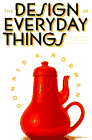
You can't start doing user interface design without reading the (now classic) book,
The Design of Everyday Things by Don Norman. If you've ever been frustrated
by a faucet that you can't seem to turn on, this book is for you. Norman looks
at everything from door handles to radios to refrigerator controls trying to
understand not only why they are hard to use, but how they could be made better.
Everything he teaches is directly applicable to all product design, including
computer screen design.
(The book was originally titled The Psychology of Everyday Things, but
he changed the title because it sounded too stuffy.) This was Don Norman's first
book and it remains his best.
|
|
In About Face: The Essentials of User Interface Design, Alan Cooper takes to task
the very essence of what has become the standard windowed interface. Among other
maxims to live by, "Don't make the user look stupid" has to be one of my favorites.
This book is not a how-to book. A better manual for that is Kevin Mullet and Darrell
Sano's Designing Visual Interfaces (below). About Face is a very insightful look at
how we have built up a "standard" graphical environment on some (possibly) flawed
assumptions. I consulted on a large project where the project manager bought a
copy of this book for every member of the team. He would often be heard spouting
"Cooper-isms", and he was right! Alan Cooper knows his stuff.
|
|
Designing Visual Interfaces simply changed my life. When I go into a bookstore
scanning the user interface design section, I am appalled to discover how many
books on user interface design are either poorly organized or poorly laid out.
Often they don't even have an index! Designing Visual Interfaces is a book which
is as beautiful to look at as to read. But it is more than that. The book offers
a rare connection between computer screen design and basic graphic arts techniques.
What is form? How should color be used appropriately? What about the white
space? The book is a must read for anyone doing user interface design, and it
doesn't matter whether you are doing on a Mac, a Sun, a terminal, or a PC, their
advice applies.
|
|
If you liked Don Norman's The Design of Everyday Things, you'll really
enjoy Henry Petroski's The Evolution of Useful Things. If someone told
you that there was an entire book about the development of the paper clip, you'd
surely laugh. But it does exist, and it is this book. Petroski looks at the things
we use everyday, like pens, forks, and (oh yes) paper clips, and tries to figure
out what makes them so easy to use. This book is a must for every budding
designer.
|
|
|
Graphic Design
|
|
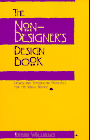
No, Mork didn't start writing books on graphic design. The Non-Designer's Design
Book by (the female) Robin Williams is an excellent book on basic page layout
for the rest of us. How do you take that boring old poster which has all the text
centered and make something interesting out of it? How do you lay out a business
card so that people think it was done professionally? Her simple advice about design,
type, and readbaility is invaluable. Every time I sit down to do a new layout,
I seem to pick up this thin book for a refresher course.
|
|
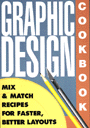
Have you ever bought a book that had no words in it? I have, and it didn't take long
to decide to buy it, either. The Graphic Design Cookbook is nothing but a
thousands of page layouts, all done in a graphical manner. I use this book as an
idea generator. Let's see, I have a picture, a title, and a bunch of text that I
want to put onto the page in a fresh way. This book helps you do it. It is a
reference book in my library the same way that a english major might use a
dictionary.
|
|
|
Architecture
|
|
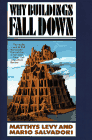
If you're like me, you see these terrible disasters on the news everyday and
wonder how we can build so many things that fall apart and kill people.
Why Buildings Fall Down is written by Stuart Levy, who heads the company
Failure Analysis, Inc. This company has investigated every major disaster in
the 20th century. They are always called because they are great detectives and
they do find the bolt which caused the building to collapse. If you are someone
who keeps asking, "Why?", this book is for you. It's fun reading.
|
|
|
|